
Interview: LILLY Filmmaker Rachel Feldman
Updated: Sep 1

Recently, we had the pleasure of speaking with Kate Kelley on the topic of the independent film Lilly. Today we get into more details, talking to Rachel Feldman, the director of the film, about fair-pay activist Lilly Ledbetter, starring Patricia Clarkson.
Sylvia: Producing an indie film is more challenging than ever. What motivated you to take on that challenge and bring us Lilly’s timely story?
Rachel: As filmmakers, when bringing any story to life, we need to make sure that the themes we share with the world will leave an impact and reverberate through culture. Not only was Lilly's story about gender equity and fair pay, it’s a narrative about persistence and determination. LILLY is a movie about an ordinary person who did an extraordinary thing. I always loved social justice movies, even before I knew the term. How Green Was My Valley was something my mother introduced me to. You root for the little guy, for the underdog. Particularly when the underdog is a woman like Norma Ray, Erin Brockovich, women in films like Silkwood and North Country. I hadn't seen one of those kinds of films for a long time. Lilly's story worked in that way.
I didn't need to dramatize or fictionalize anything. Her compelling life organically fell into screenplay structure. I got to know Lilly very well. She was a special human. Having the film made was very important to her, and I wanted to honor her in every way that I could. It was something I could do for her on a personal level, and I could share that story with the world so folks would be inspired.

Sylvia: I thoroughly enjoyed the film. I especially loved how she found out what was being done to her. Someone with a conscience stepped forward and slipped her an anonymous note. They never found out who the co-worker was who tipped her off?
Rachel: There are different theories, but she went to her grave sticking to the fact that she didn't know. Maybe she really didn't, or perhaps she was protecting someone.
Sylvia: Exactly. It's wonderful that she chose to protect them. I agree, it was such a compelling story, and you mentioned that the gender discrimination Lilly faced in the factory is similar to what you've faced in the film industry. The Conscious Media Movement addresses those issues as well. Only a minuscule percentage of directors hired by studios are women. Opportunities are kept from them. The lack of female filmmakers is detrimental to society because it results in too many narrow, stereotypical storylines that don’t honestly reflect the life experiences and views of more than half the population. It leaves women’s perspectives and wisdom largely absent from the stories that are meant to reflect or teach us about life. So, most of us can relate to Lilly’s dilemma. Can you elaborate more about this?
Rachel: Yeah, absolutely. I wouldn't say that her discrimination was the same as mine, but in the end, all discrimination emanates from the same root. Lilly lived through very painful experiences: sexual abuse, physical abuse. It was a toxic environment emotionally and environmentally. (She eventually died of lung cancer.) They were awful to her. I hope your readers will read the beautiful book, Grace and Grit, which she co-wrote with writer Lanier Scott Isom. It details the injustices and the cruelty she experienced. I actually had arguments with my lawyers who were trying to protect me from being sued because they thought I was exaggerating or embellishing. The reality was much worse than what’s in the film. I highly recommend that people read the book.

Credit: Blue Harbor Entertainment
As a female filmmaker in Hollywood, gender inequity exists in the form of exclusion, lack of opportunity, or access. Once you get the job directing an episode of TV, we are all paid the same because of our guild. Lilly recognized this. She thought that in some ways, she had it better than me. She would say, “At least I got the job. They cheated me, but I was earning, working, but for a long time, you women couldn’t even get in the door.”
Sylvia: Yes, absolutely. The clear loss of opportunity is huge. And there are issues with pay equity in the film industry, though I agree it's improving, especially after the Michelle Williams incident. Following the removal of Kevin Spacey from All the Money in the World (2017), the required reshoots created an opening for a massive pay disparity: Mark Wahlberg was paid $1.5 million, while Michelle Williams received less than $1,000 (roughly $80 per day). And she was the actor with the Golden Globe Award and Primetime Emmy Award, out of the two. When it all came out, Wahlberg donated his fee to the Time's Up movement in Williams' name. This created flashbacks to other women in film who spoke up in the past but weren't being heard, and were instead called "difficult to work with."
Rachel: Patti Clarkson talks about that in her own career.
Sylvia: More men are speaking up for women after what came to light for all to see with the Michelle Williams incident. That is wonderful to see. You are right, things are changing, but still, the doors aren’t flinging open for us behind the camera. So, that's my next question: what were the most significant gems or insights you can share with other filmmakers trying to get their projects greenlit, because there must have been all sorts of hurdles put in your way regarding that?
Rachel: The industry is in bad shape right now. The perspective I share with you is not necessarily applicable because opportunities have become so slim; the funnel is pretty tight right now. When I first optioned the rights to Lilly’s story, I wrote a screenplay immediately that won some awards and offered some confidence.
Over the next five years, I optioned the script to four different, well-known Hollywood producers, two of whom are Oscar winners. And by the way, I did this without the help of agents. But these successful producers couldn't get the film off the ground. I don’t know if it was for lack of trying or the nature of the project, but for several years, I just kept believing I could get it done through the system. At the end of the five years, I was confronted by my promise to Lilly that I would get this film made, no matter what. So, I figured that I was going to have to raise the financing myself, which I'd never done before, and I never wanted to do. I don't come from wealth; this was not a language I was comfortable with. But serendipity came my way in a magical kind of way. I met some great people who helped me meet financiers who cared about the project. And even COVID ended up being a kind of blessing in disguise because I didn't have to get on an airplane and cater luncheons to speak to potential financiers. Lilly would get on the video calls with us. She was a magnet. Everybody loved her. There were many mature women of wealth who came from a variety of careers, yet all had experienced some form of gender discrimination in their own lives. The wind beneath our wings was from other women who'd experienced this. That added a tremendous amount of responsibility. Now I felt responsible not only to Lilly but to all these amazing women (and some men) to get this made and sold. It energized the project because now we had a large group all rooting for us and believing in our mission. Our investor/donor community was amazing.
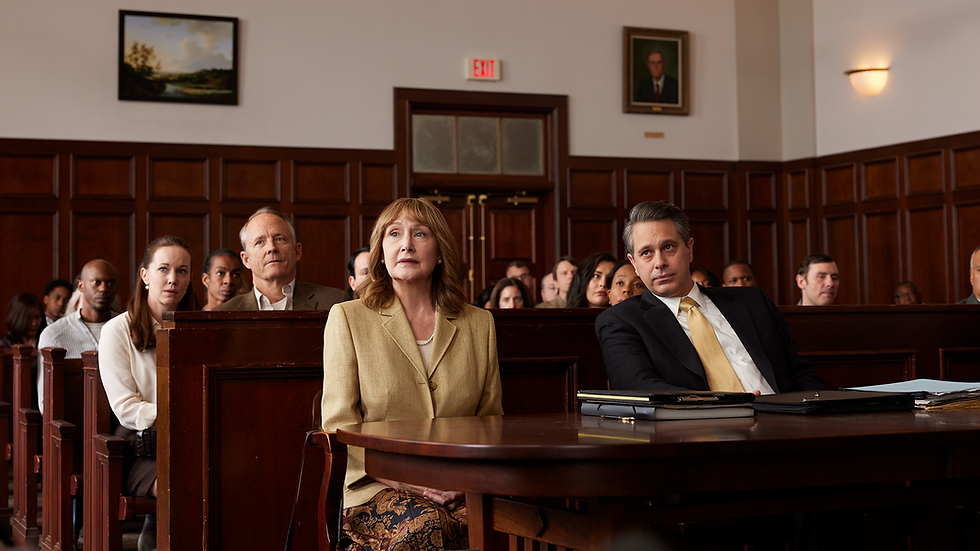
Patricia Clarkson, John Benjamin Hickey, and Thomas Sadoski in LILLY Credit: Blue Harbor Entertainment
Sylvia: I can imagine, and that’s pretty exciting. How do you hope that this film influences the conversation, since there are still issues around equal pay?
Rachel: I didn’t make this film for a political reason; I made Lilly to be an entertainment. I'm not a documentary filmmaker. I wanted to make a film that was entertaining about a remarkable woman. But when a film makes an audience feel things—they start to think. So, yes, I hope that young women think about negotiating their salaries differently, which was very important to Lilly. And I hope that it opens people's eyes up to gender inequity and all kinds of injustice.
Sylvia: I hear you. While watching a movie, we walk in someone else’s shoes for a bit, and that can open our minds to new perspectives and inspire our choices. Thank you so much for everything you have shared.
Rachel: There is one last thing I would like to share with filmmakers, because I think in this moment in time, it's crucial to talk about distribution. It’s one thing to get your film financed, another thing to get your film made, but in this moment in time, to get your film distributed could be the most difficult part of the process.
Sylvia: That’s unexpected. One would think that once one goes through the herculean effort of getting a film made, you have gotten through the hardest part.
Rachel: I recommend that any filmmaker who's going to take on making a film right now start thinking about the endpoint before you begin. Who are you selling it to? How are you selling it? Because sales are not open to the industry in the way that they used to be. Ask yourself, what is your film? Who is your audience? Where do you think you can sell it? You need to do your research. Who's buying those films? Who's left on the planet who's buying independent films?
Horror films, broad comedy, action adventure, established IP, or an extraordinarily “valuable” actor still lead the way. Dramas are very hard to sell. Original material is hard to sell. That's why I think it's really important that indie filmmakers, or NonDē filmmakers, if you prefer that description, think as low-budget as you possibly can.
Sylvia: I tend to write scripts for the fantasy genre, which is difficult to create on a low budget, but not impossible.
Rachel: When you’re driven to make something. If you're a potter, a painter, if you're passionate to create, you have to take the spirit that's driving and try to fit it into a thimble. Maybe you don’t tell the entire story, but focus on one tiny little thread of it. I don't have the answers, and neither does anybody else right now. But we can no longer go blithely forward, thinking that the great idea wins. Block the merger!
Sylvia: Consolidation of all the studios, yes; that's a nightmare and the end of a lot of creativity. That needs to change.
Rachel: Then there are the trickle-down effects. There are fewer distributors, and there are fewer buyers. And the people who are in charge are businesspeople who don't really care about a good original idea. They just want to make money.
Sylvia: Well, that's disheartening. But do you think there's going to be a shift again? Or do you think it's going to get worse before it gets better?
Rachel: It's going to get much worse
Sylvia: Especially with AI now, right?
Rachel: I don't worry about AI. We just have to try to advise our other creatives to use it wisely and to always have a human behind it. I am more worried about humans. I believe there is a future to build, but we have to create it. But we have to completely rethink our approach.
Sylvia: Yes, use AI sparingly and wisely. Don’t get sucked in and trade your creativity for convenience. You will lose more than you gain. If we use our minds in an innovative manner, do you believe there is something filmmakers themselves can create outside the studio system?
Rachel: Yeah, I do. I think we can reinvent a kind of distribution ourselves. But you can't sit around and wait for somebody else to do it. You have to do it!
Sylvia: I totally agree with you.
Rachel: People are collaboratively buying small, independent movie theaters and showing their films, figuring out a way to market them themselves. There are so many innovations happening now, interesting modes of distribution. The future is now.
Sylvia: For sure. Creative, out-of-the-box thinking—that is what is required now. Thank you, Rachel, for your insights and the motivation.
Rachel: Thank you, and good luck to all of us.

Rachel Feldman is an experienced director of television series and long form films, with credits including Blue Bloods, Criminal Minds, The Rookie, and earlier classics like Doogie Howser, M.D., Dr. Quinn, Medicine Woman, and The Commish. She recently wrote and directed her first theatrical feature, Lilly, starring Patricia Clarkson, John Benjamin Hickey, and Thomas Sadoski, which is now streaming on Netflix. Feldman believes in the power of storytelling to create meaningful change and sees it as her responsibility to craft entertainment that challenges norms and contributes to a better world.
Credit: Greg Crowder


Comments